

Quick Answer: Only partly. Keeping sweets to one sitting, ideally with a meal, does give your teeth more time to recover than snacking all day. But the amount still matters: research shows more sugar means more decay, and WHO limits still apply. After sweets, drink water and wait about an hour before brushing. That is the honest picture of sweets and your teeth.
Key Takeaways
- How often you eat sugar matters, but so does how much.
- Each sugary snack starts an acid attack that softens enamel.
- Wait about an hour before brushing after sweets.
- WHO advises keeping free sugars below 10% of daily energy, and ideally below 5%.
- Early decay is simpler to treat, and Tabby and Tamara can spread the cost.
A popular social media message says you can eat as many sweets as you like, as long as it is once a day and you do not brush straight afterwards. Like many viral tips, it mixes good science with a risky shortcut. Our team follows new research closely and checks it against trusted guidelines before changing our advice. Here is what the evidence says about sweets and your teeth.
Is It True You Can Eat Unlimited Sweets If It Is Only Once a Day?
Partly true, partly false. Eating sweets in one sitting is kinder to your teeth than grazing on them all day, because your mouth gets fewer acid attacks. However, large studies show the amount of sugar still drives tooth decay. “Once a day” helps; “as much as you want” does not.
The true part is about timing. The NHS advises limiting sugary food and drink to mealtimes, and the American Dental Association notes that meals cause less harm than snacking because they produce more saliva.
The false part is about quantity. A long-term study of Finnish adults, published in the Journal of Dental Research in 2016, found that the amount of sugar eaten was more strongly linked to new decay than how often it was eaten. A 2015 review in the same journal found that decay risk rises steadily with sugar intake.
What Happens to Your Teeth After You Eat Sweets?
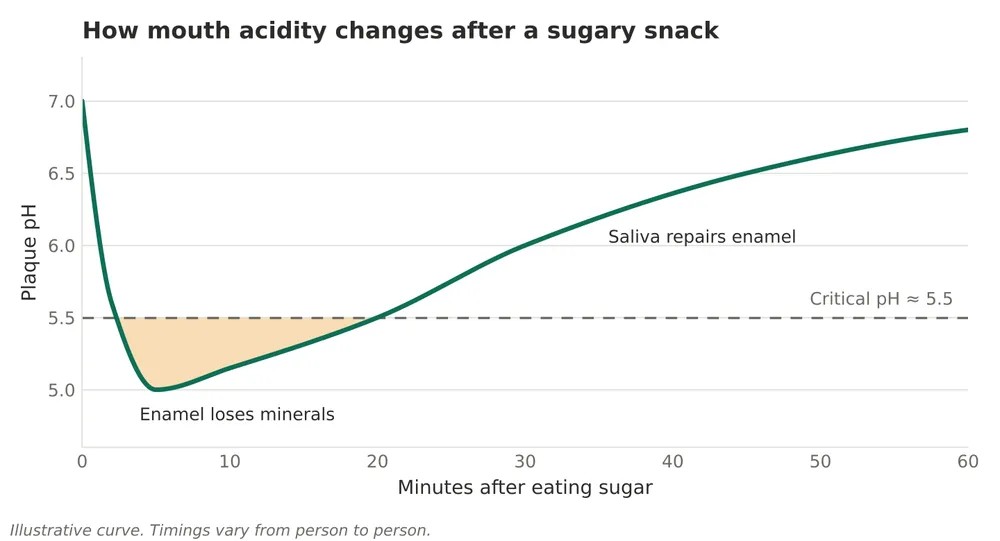
When you eat sugar, bacteria in dental plaque turn it into acid. That acid draws minerals out of your enamel and softens the surface. Saliva then slowly neutralises the acid and helps put minerals back. Decay starts when acid attacks happen faster than your saliva can repair the damage.
Dental caries is the medical name for tooth decay: the gradual destruction of tooth structure by bacterial acids. Demineralisation is the loss of minerals from the enamel, the tooth’s hard outer layer, during an acid attack.
Dentists generally treat a pH of about 5.5 as the “critical pH”, the point at which enamel starts to dissolve. After a sugary snack, the pH around your teeth drops below this level, then rises again as saliva works. This is the “pH level” the viral advice refers to, and every extra snack restarts the cycle.
According to the World Health Organization, oral diseases affect nearly 3.7 billion people, and untreated decay in permanent teeth is the most common health condition worldwide.
Does How Often You Eat Sugar Matter More Than How Much?
Both matter. Frequency decides how many acid attacks your teeth face each day, while the total amount decides how much fuel the decay-causing bacteria receive. Cutting down on frequency without watching the amount, or the other way round, only does half the job.
The World Health Organization recommends keeping free sugars below 10% of total energy intake, and suggests that below 5%, about 25 grams or six teaspoons a day, brings extra benefits. The NHS sets a practical limit of no more than 30 grams of free sugars a day for adults, roughly seven sugar cubes.
In Dubai, sugar often arrives quietly: sweetened karak tea, fresh juices, Arabic sweets after dinner and the dessert table at Friday brunch. A large serving of kunafa can use up much of the daily limit on its own.
How Long Should You Wait to Brush After Eating Sweets?
Wait about one hour. Sugary and acidic foods soften enamel for a while, and brushing too soon can wear the softened surface away. The Oral Health Foundation advises waiting at least an hour after eating before brushing, and suggests water or sugar-free gum in the meantime.
This part of the viral advice is sound, but do not skip brushing. The NHS recommends brushing twice a day for about two minutes, including last thing at night, with a fluoride toothpaste of at least 1,350 ppm for adults. After brushing, spit out the excess and do not rinse, so the fluoride stays on your teeth.
A simple routine for sweet lovers looks like this:
- Have sweets with or straight after a meal, not as a separate snack.
- Drink water afterwards, or chew sugar-free gum for about 20 minutes.
- Avoid sipping sweet drinks or sucking sweets over a long period.
- Wait about an hour, then brush with fluoride toothpaste, especially before bed.
How Do We Check “New Research” Before Changing Our Advice?
We ask four questions. Was the study published in a peer-reviewed journal? Was it done in people, and how many? Do other studies and major guidelines, such as those from the WHO and NHS, agree? And does the headline match what the study actually found? Advice changes only when the answers hold up.
The research on sugar frequency is genuine, but it was never a licence to eat unlimited sweets. You can use the same four questions whenever a health claim sounds too good to be true.
Is Cheap Dental Treatment Really Cheaper When Decay Is Involved?
Not always. Decay found early can often be treated with a small filling or preventive care. Missed decay can grow into the nerve and need a root canal, a crown or even an extraction. A lower price that skips X-rays or rushes the work can cost more over five years.
| Factor | Price-first approach | Value-based approach |
|---|---|---|
| Diagnosis and X-rays | Quick look; X-rays often skipped | X-rays when needed to spot hidden decay |
| Materials | Lowest-cost option, little explanation | Chosen for the tooth and explained |
| Treatment planning | Treats only the tooth that hurts | Plan covering all teeth, diet advice and fluoride |
| Experience | Little continuity between visits | Experienced dentist, with specialist referral when needed |
| Aftercare and warranty | Terms unclear or verbal only | Follow-up, with warranty terms in writing |
| Likelihood of redo work | Higher: early decay and weak margins may be missed | Lower: problems treated while still small |
| 5-year total cost | Low per visit, but risk of root canals, crowns or extractions | Steadier, more predictable spending |
Cheap dental treatment can look affordable on the day, but untreated or poorly treated decay rarely stays small. Value-based care aims to keep both your teeth and your total spending under control.
General Dentist vs Specialist: Who Should Treat What?
A general dentist is your first point of contact for check-ups, decay, fillings and early gum disease. A specialist has completed further postgraduate training in one area and suits complex or higher-risk cases. The strongest arrangement is a team that refers between them.
An oral and maxillofacial surgeon is trained in surgery of the mouth, jaws and face. An orthodontist straightens teeth and corrects the bite. A periodontist specialises in gum disease, and an endodontist in root canal treatment.
| Treatment | Usually handled by GP | When a specialist is better | Why it matters long term |
|---|---|---|---|
| Gum disease | Gingivitis and early gum disease | Advanced or fast-progressing disease (periodontist) | Healthy gums protect the bone that holds teeth |
| Root canals | Straightforward teeth | Curved canals or retreatment (endodontist) | Can save a tooth that decay has reached |
| Wisdom teeth | Simple, erupted teeth | Impacted teeth or teeth near nerves (oral surgeon) | Lower risk of nerve injury and infection |
| Implants | Assessment and planning | Bone grafts or multiple implants (oral surgeon) | Correct placement affects lifespan |
| Braces and aligners | Screening and minor cases | Most bite and alignment cases (orthodontist) | Straight teeth are easier to clean |
| Veneers and crowns | Single crowns and fillings | Smile makeovers or multiple units (restorative dentist) | A precise fit avoids new decay at the edges |
Most decay is managed by a general dentist; when it reaches the nerve or a tooth needs complex rebuilding, specialist skills protect the result.
At Sonrisa Dental Clinic, Dr Rahaf Abbas, General Dentist (7+ years), leads check-ups and fillings, working alongside Dr Altayyeb Abu Asbeh, Oral and Maxillofacial Surgeon (20+ years); Dr Ahmed Ghazal, Orthodontist (10+ years); and Dr Khalid Abu Taqiya, Restorative and Cosmetic Dentist (8+ years). If you need a dental specialist in Dubai, the right colleague is often in the same building.
How Can Tabby and Tamara Help You Treat Decay Early?
Tabby and Tamara are buy-now-pay-later services that split the cost of treatment into smaller instalments. Instead of delaying treatment or choosing the lowest price, you can follow the plan your dentist recommends and spread the payments, subject to each provider’s eligibility checks and terms.
For families in Jumeirah Village Circle juggling school fees and busy schedules, a dental bill is easy to postpone, yet decay grows while you wait. Being an affordable dental clinic in JVC should mean clear prices, a written plan and flexible payment, not shortcuts.
What Should You Look For in an Affordable Dental Clinic in JVC?
Look for a clinic licensed by the Dubai Health Authority (DHA) that explains what the price includes, checks for decay properly, gives you practical diet advice and provides a written plan. Affordability should come from transparency and flexible payment, not from skipped steps.
A good dentist in JVC should be happy to answer these questions:
- Will you take X-rays if you need to check for hidden decay?
- Who will treat me, and can I see a specialist if needed?
- Will I receive a written plan and estimate?
- Are instalment options available?
If you are searching for an affordable dentist in Dubai, clear answers matter more than the headline price.
Ready to Talk About Sweets and Your Teeth?
You do not have to give up sweets. Keep them to mealtimes, watch the amount, drink water and wait about an hour before brushing, with regular check-ups to catch early decay. That is what the research on sweets and your teeth supports.
Sonrisa Dental Clinic is a DHA-licensed dental clinic in Dubai, located in Jumeirah Village Circle (JVC). Established in 2024, the clinic combines general and specialist dentistry, with some clinicians offering over 20 years of expert dental care, and accepts Tabby and Tamara. To book with a dentist in JVC, call 0505049292 or visit sonrisadc.ae.
Disclaimer: This article is for general education only and is not a diagnosis. People with diabetes or other medical conditions should follow their doctor’s dietary advice. Always consult a licensed dentist about your own situation.
Frequently Asked Questions
Should I brush my teeth straight after eating sweets?
No. Sugary and acidic foods soften enamel for a while, and brushing too soon can wear it away. The Oral Health Foundation advises waiting at least an hour. In the meantime, drink water or chew sugar-free gum. Then brush with fluoride toothpaste, and do not skip your night-time brush.
Is it better to eat sweets with a meal or as a snack?
With a meal. You make more saliva during a meal, which helps neutralise acid, so your teeth face one acid attack instead of several. The NHS and the American Dental Association both advise this, but it only helps fully when the total amount is also kept low.
How much does treating tooth decay cost in Dubai?
It depends on how far the decay has gone. A small filling, a root canal and a crown are very different treatments with different fees, which is why finding decay early matters. Ask any dental clinic in Dubai for a written, itemised estimate. For current prices at Sonrisa Dental Clinic, call 0505049292.
Can I pay for dental treatment in instalments?
Yes. Tabby and Tamara let you split eligible treatment costs into smaller payments, with approval and terms set by each provider. Instalments are most useful when a check-up finds decay that needs treatment, so you can act early instead of waiting until the problem becomes larger.
Should I see a general dentist or a specialist for tooth decay?
Start with a general dentist, who can diagnose decay, place fillings and give prevention advice. If decay has reached the nerve, or a tooth needs complex rebuilding or surgical removal, you may be referred to another dental specialist in Dubai.
What are the red flags when a dental price seems very low?
Look at what may be missing rather than the number itself. Warning signs include no X-rays when decay is suspected, no written plan, unclear inclusions, verbal-only warranty promises or pressure to pay upfront for extra work. A fair price with written inclusions is a good sign.
How can I judge whether a dental clinic is right for me?
Check that the clinic is DHA-licensed, ask who will treat you and about their experience, and request a written plan and estimate. A good clinic explains your options, including what can wait, and gives practical prevention advice. Being close to home also helps.
Sources & References
- World Health Organization (WHO). Guideline: sugars intake for adults and children. 2015. https://www.who.int/publications/i/item/9789241549028
- World Health Organization (WHO). WHO calls on countries to reduce sugars intake among adults and children – News release. 4 March 2015. https://www.who.int/news/item/04-03-2015-who-calls-on-countries-to-reduce-sugars-intake-among-adults-and-children
- World Health Organization (WHO). Oral health – Fact sheet. 17 March 2025. https://www.who.int/news-room/fact-sheets/detail/oral-health
- Bernabé E, Vehkalahti MM, Sheiham A, Lundqvist A, Suominen AL. The shape of the dose-response relationship between sugars and caries in adults. Journal of Dental Research. 2016;95(2):167–172. https://journals.sagepub.com/doi/10.1177/0022034515616572
- Sheiham A, James WPT. Diet and dental caries: the pivotal role of free sugars reemphasized. Journal of Dental Research. 2015;94(10):1341–1347. https://journals.sagepub.com/doi/10.1177/0022034515590377
- NHS (UK National Health Service). Sugar: the facts. Accessed October 2026. https://www.nhs.uk/live-well/eat-well/food-types/how-does-sugar-in-our-diet-affect-our-health/
- NHS (UK National Health Service). How to keep your teeth clean. Accessed October 2026. https://www.nhs.uk/live-well/healthy-teeth-and-gums/how-to-keep-your-teeth-clean/
- Oral Health Foundation. Diet and healthy teeth. Accessed October 2026. https://www.dentalhealth.org/diet-and-my-teeth
- American Dental Association, MouthHealthy. Diet and Dental Health. Accessed October 2026. https://www.mouthhealthy.org/all-topics-a-z/diet-and-dental-health


