A teenager files down her own front tooth with a nail file live on camera. A father slips a tiny rubber band around his son's gapped incisors to "close it overnight." Millions watch, and thousands try it at home. This is the viral "DIY dentist" trend now sweeping social media in 2026, and dental professionals …

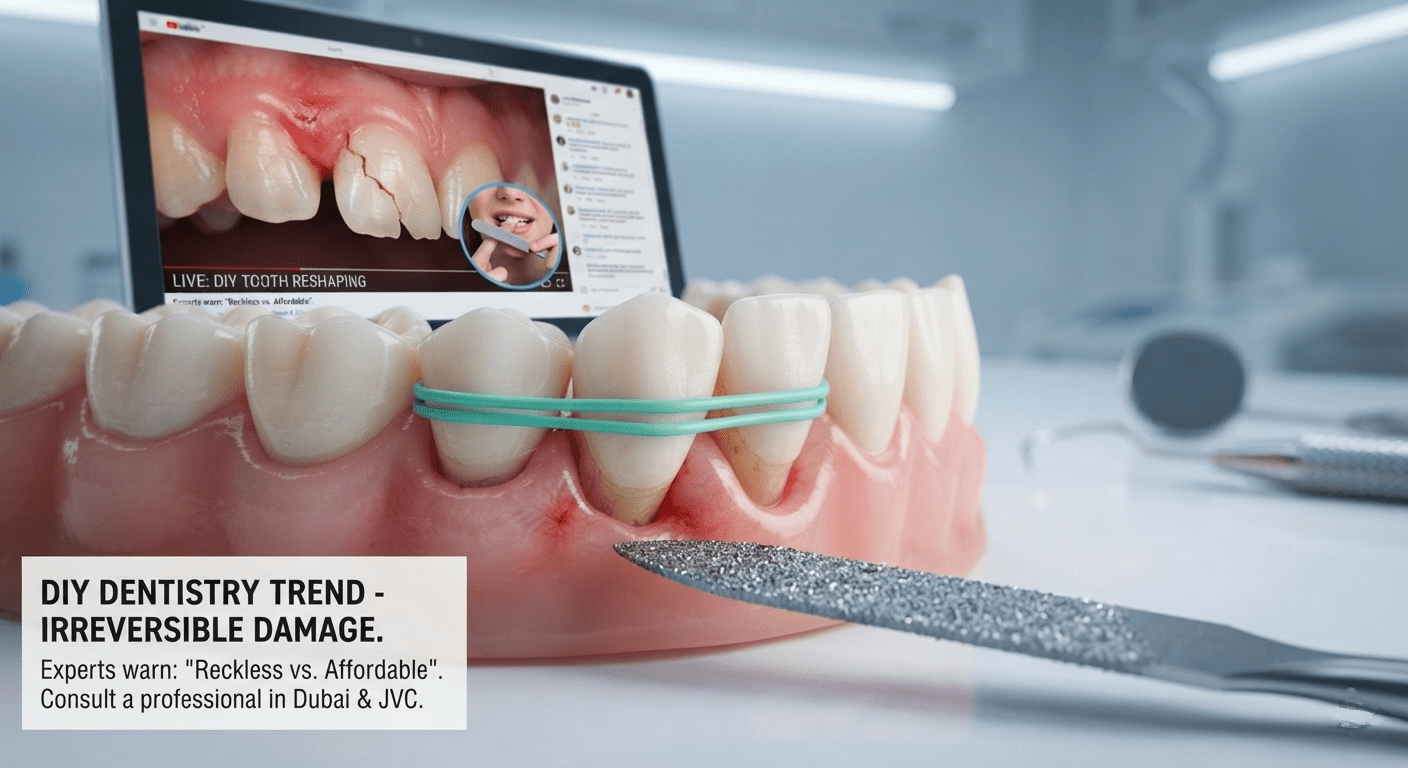
A teenager files down her own front tooth with a nail file live on camera. A father slips a tiny rubber band around his son’s gapped incisors to “close it overnight.” Millions watch, and thousands try it at home. This is the viral “DIY dentist” trend now sweeping social media in 2026, and dental professionals across the UK, US, and Gulf region are warning that the damage it causes is often irreversible. For residents of Dubai and JVC searching for a quick, low-cost fix, the trend raises an urgent question: when does “affordable” cross the line into “reckless,” and what does genuinely expert service actually look like?
What Is the “DIY Dentist” Trend Sweeping Social Media?
The trend covers a cluster of at-home hacks: filing teeth with nail files or emery boards to reshape them before “snap-on” veneers, wrapping elastic “gap bands” around front teeth to close spaces, charcoal powders marketed as whitening miracles, and mail-order clear aligners worn with zero clinical supervision. The appeal is obvious — these hacks look free or nearly free compared with a visit to a real dentist, and the videos are edited to make the results look instant. What the clips rarely show is the follow-up visit, the infection, or the tooth that could not be saved.
The American Dental Association has publicly flagged these social media trends as a genuine public-health concern, and the American Association of Orthodontists has issued specific warnings about at-home teeth filing and DIY orthodontic devices. In the UK, a British Dental Association survey found that 82% of dentists polled had treated patients who had attempted some form of DIY dental work on themselves, including cases involving pliers, superglue, and even chewing gum used as a substitute filling. This is not a fringe curiosity; it is now something almost every practising dentist has encountered.
Why Your Enamel and Gums Can’t Simply “Reset”
The biology here is unforgiving. Tooth enamel is the hardest tissue in the human body, but it has no living cells and cannot regenerate once it is filed away. The American Association of Orthodontists is blunt about this: enamel removed at home with a nail file is gone permanently, and over-filing raises the lifelong risk of sensitivity, decay, and fractures that later require a specialist to repair with a crown or bonding. A cheap five-minute video hack can therefore create a problem that takes years and several visits to a specialist to properly correct.
Gap bands carry an even sharper risk. Because tiny elastic bands are placed with no clinical measurement of root angulation or bone support, they frequently slip beneath the gumline instead of resting on the visible tooth surface. A widely cited case involved an eight-year-old whose parents used a rubber band to close a front-tooth gap; the gap disappeared within two days, but so did the band — it had migrated under the gum and destroyed more than 75% of the supporting bone before anyone realised what was happening. Despite emergency treatment from a specialist team, both front teeth ultimately could not be saved. A peer-reviewed case report in the dental literature documents an almost identical pattern of elastic-band-induced periodontitis leading to tooth mobility and loss. These are not isolated horror stories; they are the predictable result of skipping a trained dentist.
Quality vs. Cheap: What You’re Really Comparing
| Factor | “Cheap” DIY / Unlicensed Shortcut | Specialist-Led Care at a Licensed Dental Clinic |
|---|---|---|
| Upfront cost | Free–low cost (household items, mail-order kits) | Transparent fee, often payable via Tabby or Tamara instalments |
| Diagnosis | None — no X-rays, no bone or bite assessment | Digital imaging and a qualified dentist’s clinical exam before any treatment |
| Who performs it | The patient, an influencer, or an unlicensed operator | A DHA-licensed specialist with years of verified training |
| Risk of irreversible damage | High — enamel loss, bone loss, infection, tooth loss | Low — procedures are planned, sterile, and monitored |
| Long-term cost if it goes wrong | Root canal, extraction, implants, or corrective specialist work | Predictable, once, done properly |
The table makes the trade-off explicit. A “cheap” fix that costs nothing today can generate the single largest dental bill of someone’s life a year later, once a specialist has to rebuild what a rubber band or a nail file destroyed. Genuinely affordable care is not the same as cheap care — affordable means a fair, transparent price for expert service delivered safely; cheap, in the DIY sense, means no price and no safety net at all. Across Dubai and JVC, patients who understand this difference are the ones who avoid the costliest surprises down the line.
Short-Term Relief vs. Long-Term Impact
| Timeframe | DIY / Viral Trend Outcome | Professional Dental Clinic Outcome |
|---|---|---|
| Day 1–7 | Gap looks smaller, teeth look “filed” and even | Consultation, diagnosis, and a personalised treatment plan |
| Month 1–3 | Sensitivity, gum irritation, or the band disappears under the gum | Treatment progresses under a specialist’s supervision, with adjustments as needed |
| Year 1 | Possible infection, bone loss, or a tooth that has become mobile | Stable, natural-looking results with a maintenance plan |
| Year 3–5+ | Extraction, implant, or extensive corrective work by a specialist | Long-term oral health preserved, follow-up visits keep issues minor |
This is precisely why dental associations keep repeating the same message every time a new hack goes viral: what looks like a shortcut today is frequently the most expensive and painful route in the long run, because it eventually forces a return to a real dentist — just later, and at a much higher cost.
General Fixes vs. Specialist Work: Why Credentials Matter
Not every dental concern needs a specialist, but cosmetic reshaping, orthodontic movement, and restorative repair absolutely do. A general online tutorial cannot assess bite, root position, bone density, or gum health — a trained dentist can, using X-rays and a physical exam. At a properly regulated Dental Clinic, a suspected gap or crowding case is typically reviewed by an orthodontic specialist before any device touches the teeth, and cosmetic reshaping is planned by a restorative specialist using tools such as Digital Smile Design rather than a nail file. This is the difference between guessing and expert service: a specialist is trained to recognise exactly how much enamel can safely be adjusted, whether a gap needs bands, aligners, or braces, and when a case is unsuitable for a cosmetic shortcut at all. Any Dental Clinic offering that level of expert service in Dubai should be able to show DHA licensing and named specialist credentials before treatment ever begins.
Why Sonrisa Dental Clinic Is the Affordable Alternative to DIY in JVC, Dubai
Sonrisa Dental Clinic was established in 2024 in Binghatti Emerald, Office 314, in Jumeirah Village Circle (JVC), Dubai, specifically to give residents a real, expert service alternative to both overseas dental tourism and social-media DIY hacks. As a DHA (Dubai Health Authority) licensed Dental Clinic, Sonrisa Dental Clinic is held to regulatory standards that no rubber band or nail-file tutorial can meet. The team brings more than 45 combined years of experience: a general dentist with 7+ years in restorative and cosmetic care, an oral and maxillofacial surgeon and implantologist with over 20 years of experience, an orthodontic specialist with 10+ years treating gaps and misalignment with braces and clear aligners, and a restorative and cosmetic specialist with 8+ years in veneers, crowns, and smile design.
For anyone in Dubai tempted by a viral hack because a professional dentist “feels expensive,” Sonrisa Dental Clinic’s model is built around Tabby and Tamara interest-free instalments, so specialist, DHA-regulated expert service is genuinely affordable rather than a one-time luxury. That is the core distinction Sonrisa Dental Clinic wants every JVC resident to understand: affordable does not have to mean cheap, and cheap almost never turns out to be affordable once the long-term damage bill arrives. Choosing a licensed Dental Clinic in JVC over a viral shortcut is not an extravagance — it is simply the safer, and ultimately less costly, decision.
If a gap, a chip, or a shade of white is bothering you, the responsible first step is a conversation with a real dentist, not a search for the cheapest hack on your feed. Sonrisa Dental Clinic in JVC offers consultations that assess the problem properly and lay out every option — from simple bonding to full specialist-led treatment — so that Dubai residents can make an informed choice with a dentist rather than a guess with a nail file, backed by the same expert service standard every time.
Frequently Asked Questions
1. Can rubber bands actually close a gap between my front teeth?
They may appear to close a visible gap temporarily, but without clinical supervision they frequently migrate beneath the gumline, where they can destroy the bone and ligament holding the tooth in place. This is not a safe or supported orthodontic method.
2. Is filing my own teeth with a nail file really that dangerous?
Yes. Enamel does not regenerate once removed, so any mistake is permanent. Over-filing increases sensitivity, decay risk, and the chance of a fracture that later needs specialist repair.
3. Are at-home whitening kits or charcoal powders safe alternatives?
The ADA notes there is no reliable evidence that charcoal-based products are safe or effective, and some abrasive formulas can wear down enamel over repeated use. A dentist-supervised whitening plan is the evidence-based option.
4. Why do DIY dental trends keep going viral if they’re risky?
Because the visible result (a smaller gap, a “filed” smile) appears within days, while the damage — bone loss, infection, or fractures — often takes weeks or months to surface, by which point the video has already moved on.
5. Is mail-order clear aligner treatment the same as specialist orthodontics?
No. Aligners moved without a dentist’s assessment of bite, bone, and root position can cause bite problems, gum recession, and even tooth loss. A specialist orthodontist monitors progress and adjusts the plan throughout treatment.
6. How do I know if a Dental Clinic in Dubai is properly licensed?
Ask whether the clinic and its dentists are DHA (Dubai Health Authority) licensed, and check the credentials of the specific dentist or specialist who will treat you before booking any cosmetic or orthodontic procedure.
7. Is professional treatment at a Dental Clinic actually affordable compared to DIY?
When compared against the eventual cost of correcting DIY damage — extractions, root canals, or implants — professional, specialist-led treatment is usually the more affordable route over the long term, especially with instalment options like Tabby and Tamara.
8. What should I do if I’ve already tried one of these viral trends?
Stop immediately, remove any bands or devices if it is safe to do so, and book an appointment with a dentist as soon as possible so a specialist can assess whether any damage has occurred. A Dental Clinic like Sonrisa Dental Clinic can examine the area and recommend corrective expert service before a minor issue becomes a lasting one.
Sources and References
- American Dental Association — Social media trends that could cause dental harm: https://adanews.ada.org/huddles/social-media-trends-that-could-cause-dental-harm/
- American Dental Association — MouthHealthy: Do-it-yourself (DIY) Dentistry: https://www.mouthhealthy.org/all-topics-a-z/diy-dentistry
- American Association of Orthodontists — Why Filing Teeth Yourself Is a Bad Idea: https://aaoinfo.org/whats-trending/why-filing-teeth-yourself-is-a-bad-idea/
- American Association of Orthodontists — The Risks of DIY Braces: An Orthodontic Case Study: https://aaoinfo.org/whats-trending/diy-orthodontic-treatment-a-case-study/
- British Dental Association — 8 in 10 dentists seeing cases of “DIY” dentistry: https://www.bda.org/media-centre/8-in-10-dentists-seeing-cases-of-diy-dentistry/
- Healthline — Gap Bands: Risks, Dangers, and Why Not to Use: https://www.healthline.com/health/gap-bands
- PMC (National Library of Medicine) — Orthodontic elastic band-induced periodontitis – A case report: https://pmc.ncbi.nlm.nih.gov/articles/PMC3723258/
This article is for general educational purposes only and does not constitute a dental diagnosis; please consult a licensed dentist for advice specific to your own oral health.

Sonrisa Dental Team
The clinical team at Sonrisa Dental Clinic, JVC Dubai.