That flawless, blinding-white smile going viral on your feed for the price of a weekend getaway? For a fast-growing number of patients, it does not end at the "after" photo — it ends with a second bill, a third opinion, and years of repair work nobody warned them about. Across social media, the trend nicknamed …

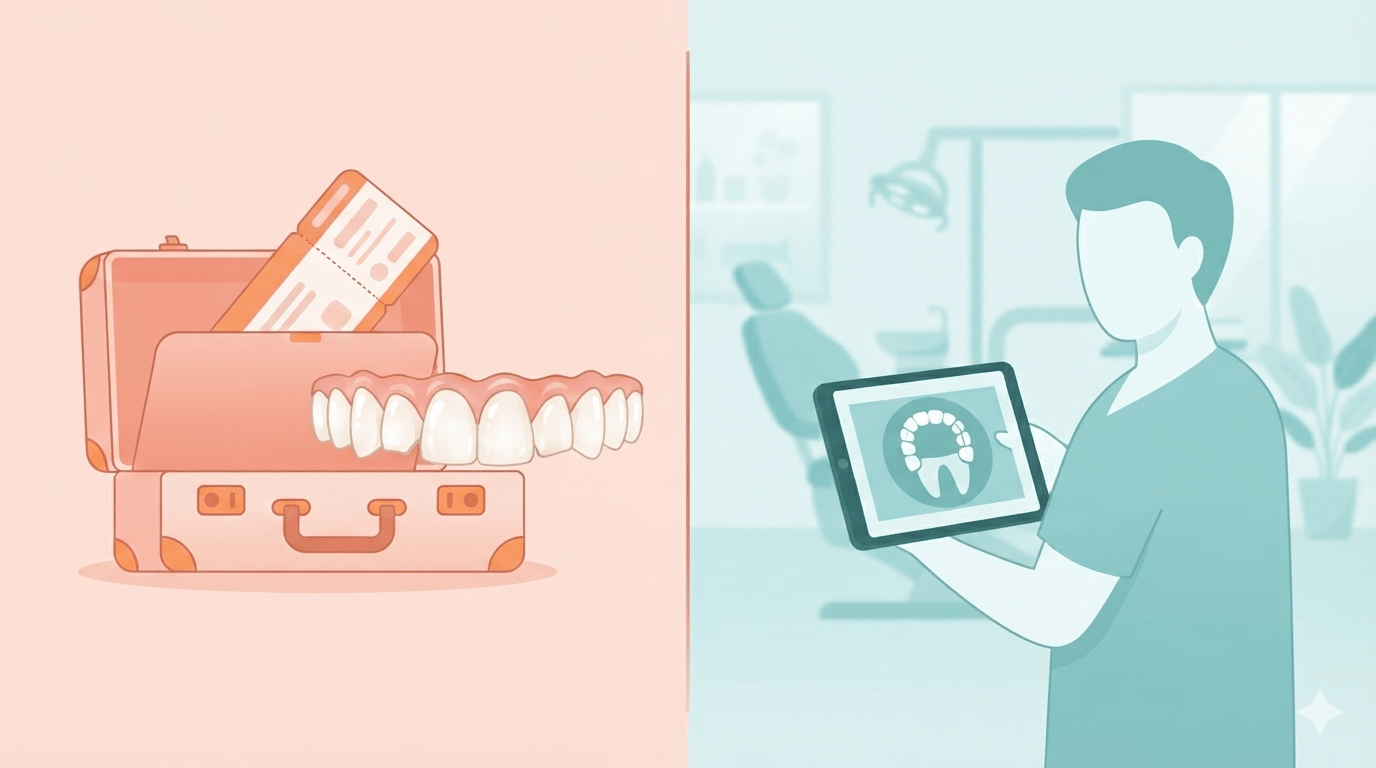
That flawless, blinding-white smile going viral on your feed for the price of a weekend getaway? For a fast-growing number of patients, it does not end at the “after” photo — it ends with a second bill, a third opinion, and years of repair work nobody warned them about.
Across social media, the trend nicknamed “Turkey teeth” has turned cut-price cosmetic dentistry into a global spectacle: procedures marketed 50–70% below home-country prices, dramatic transformations, and a camera-ready result overnight. But clinicians worldwide are now treating the fallout — and the lesson travelling home with those patients is one every resident of Dubai should hear before booking anything. In dentistry, “cheap” is often the most expensive word in the room. This guide explains why choosing care on price alone can backfire, what the science says about how long treatment really lasts, and how to find genuinely affordable, high-quality care right here in JVC.
The viral trend that turned a warning into a headline
The numbers are striking. UK patients travelling abroad for treatment rose roughly 60% between 2019 and 2022, drawn by prices a fraction of those at home. On paper, saving thousands sounds like smart shopping. In practice, the outcomes tell a messier story.
According to figures reported by the British Dental Association, 86% of surveyed practitioners had treated patients who developed problems after dental work performed overseas. The most common issues were not cosmetic disappointments — they were structural: teeth filed down far more aggressively than necessary, restorations that failed to fit the bite, nerves damaged during rushed preparation, and infections surfacing months later with the treating clinic thousands of kilometres away.
Here is the detail that surprises people most. Many believed they were getting veneers — thin shells that preserve most of the natural tooth. What a number of them actually received were crowns, which require grinding the healthy tooth down to a peg. That is not a technicality. It is often irreversible, and it changes the entire future of the tooth. The trend is simply an extreme, public version of a decision people make quietly every day: picking care by looking at the price first and everything else second.
Why “cheap” and “affordable” are not the same thing
It is worth separating two words we treat as synonyms. Cheap means paying as little as possible right now. Affordable means getting genuine value you can actually pay for — treatment that lasts, delivered by qualified hands, at a price structured to fit your budget. A good Dental Clinic helps you achieve the second; a purely budget operation only advertises the first.
The distinction matters because your mouth does not run on a one-time transaction. A filling, crown, implant, or set of veneers is a long-term relationship with a piece of engineering inside your body. Done well, you may forget about it for a decade. Rushed to hit a low price, you think about it constantly — and you pay again.
| What you are comparing | Choosing by price alone (cheap) | Choosing by value (affordable + quality) |
|---|---|---|
| Upfront cost | Lowest possible sticker price | Fair price for the materials and skill involved |
| Materials | Budget resin, generic parts, unbranded implants | Proven ceramics, branded implant systems with research data |
| Diagnosis | Often rushed; a quick look before treatment | Full assessment, X-rays, plan, bite analysis |
| Who does the work | Whoever is available | The right clinician or specialist for the case |
| Aftercare | Limited or none, especially if you travelled | Ongoing follow-up and a warranty on the work |
| Short-term result | Looks fine in the first photos | Looks natural and functions correctly |
| Long-term result | Repairs, replacements, possible tooth loss | A restoration that lasts years and protects the tooth |
| True cost over 10 years | Often higher — you pay two or three times | Often lower — you pay once, properly |
Notice the last two rows. That is where the illusion breaks. A price that looks like a bargain today can become the single most expensive dental decision you ever make, precisely because it has to be redone.
The mathematics of redoing dental work
Put real evidence behind the claim, because “you get what you pay for” is easy to dismiss. Peer-reviewed research gives hard survival data for cosmetic treatment. A systematic review in the Journal of Clinical Medicine — pooling 25 studies covering roughly 6,500 porcelain laminate veneers — found a 10-year cumulative survival rate of 95.5% for well-made porcelain veneers. Composite (quicker, lower-cost) veneers pooled a survival rate of around 88%, and typically need replacing every four to eight years rather than lasting a decade.
The same research is clear on why some restorations last and others fail: material type and, crucially, preparation design and technique. In plain terms, the skill of the person doing the work is the single biggest predictor of whether you are still smiling in ten years or back in a chair paying to fix it. That is what real expert service buys — not a fancier waiting room, but work engineered to last.
Now run the arithmetic the low-price route hides. In the UK, correcting failed dental-tourism work has been reported to cost from a few hundred pounds to over £5,000 per case. The patient “saves” on the first smile, then pays again to remove the failed work, rebuild the damaged tooth, and — where the nerve is gone — add a root canal that was never needed before. The bargain did not cost less. It cost more, in instalments, with a worse result. Here is the long-term trap in one sentence: the cheapest treatment is rarely the least expensive.
General dentist or specialist? Knowing who should do what
Another place price-first thinking quietly costs you is who performs your treatment. A skilled general Dentist is the right choice for a huge range of everyday care. But complex work — surgical implants, full-mouth rehabilitation, orthodontics, difficult aesthetic cases — is where an expert’s training changes the result. A practice chasing the lowest price often has one person do everything; a quality-focused clinic matches the case to the right expert, which is what genuine expert service means in practice.
| Type of care | Best handled by a general Dentist | Best handled by a specialist |
|---|---|---|
| Check-ups, cleaning, fillings | Yes | Not usually needed |
| Simple extraction | Yes | — |
| Surgical extractions, bone grafting, sinus lift | Refer | Oral & Maxillofacial Surgeon |
| Complex or full-arch implants | Case dependent | Implantologist / Surgeon |
| Braces and clear aligners | Refer | Orthodontist |
| Veneers, smile design, full rehabilitation | Simple cases | Restorative / cosmetic specialist |
| Root canal with difficult anatomy | Case dependent | Endodontic-trained clinician |
Advanced treatment is not always required — claiming otherwise would be its own kind of overselling. The point is that a trustworthy clinician tells you honestly which category your case falls into. Choose treatment purely because it is the lowest price, and you rarely get that honesty, because that expert step is exactly what a rock-bottom price cuts out.
Regulation: the safety net a low price often removes
There is one more reason the viral “bargain smile abroad” stories end badly: regulation. If something goes wrong after you fly home, the clinic that treated you is beyond the reach of your local health authority. The Oral Health Foundation advises anyone considering treatment abroad to confirm the clinic and its clinicians are properly licensed, ask about specialty training, and check how often they perform the procedure — precisely because redress becomes difficult once you have left the country. In Dubai, that safety net is a quiet advantage of treating locally: every practitioner in the emirate is governed by the Dubai Health Authority (DHA), which enforces standards for licensing, qualifications, and conduct. When your clinician works ten minutes from home rather than in another country, accountability and aftercare are part of the expert service, not a plane ticket away.
Affordable and excellent: how to get both in JVC
Does avoiding rock-bottom prices mean dental care has to be painful on the wallet? Not at all — that is the false choice the price-first mindset creates. The real goal is value-driven care that does not sacrifice quality, and in a competitive market like Dubai that is achievable if you know what to look for:
- Insist on a proper diagnosis and written treatment plan. Understanding what you need — and what you do not — is the biggest money-saver in dentistry. Unnecessary work is the real overspend.
- Ask about materials and who is doing the work. A slightly higher price for a branded implant placed by an expert is an investment; a bargain price on an unbranded one is a gamble.
- Use interest-free payment plans instead of chasing the lowest sticker. Splitting the cost over months through Tabby and Tamara lets you afford excellent care now, rather than paying twice for a budget version later.
- Choose a DHA-licensed clinic with real specialists on the team, so complex cases are handled by the right expert from the start.
This is the philosophy behind Sonrisa Dental Clinic. Located in the heart of JVC, Sonrisa Dental Clinic was built on the belief that affordable and high-quality are not opposites — they are the whole point. Rather than competing to be the lowest-priced name around, it competes on value: honest diagnosis, proven materials, real expert service, and pricing structured so patients can say yes to the treatment that is right for them.
Why patients in JVC choose Sonrisa Dental Clinic
Established in 2024, Sonrisa Dental Clinic pairs a modern setting with a team whose experience runs deep — more than 45 years of combined clinical experience under one roof. Care is led by general Dentist Dr. Rahaf Abbas, with over seven years across restorative and cosmetic work, supported by a specialist bench most patients will only ever need for complex cases:
- An Oral & Maxillofacial Surgeon with 20+ years in implants and complex surgery.
- An Orthodontics specialist with 10+ years aligning smiles with braces and clear aligners.
- A restorative and cosmetic specialist with 8+ years in veneers, crowns, and smile design.
Every clinician here is DHA-licensed, and the practice offers Tabby and Tamara so quality care is genuinely within reach rather than something to postpone. That combination — a real expert team, honest expert service, a convenient JVC location, and flexible payments — is what lets a patient choose value without the eye-watering prices people wrongly assume quality demands. It is also the practical answer to the “Turkey teeth” cautionary tale: you never need to fly anywhere, or accept a risky bargain, to smile with confidence.
A checklist before you pick any Dental Clinic
Judge a Dental Clinic on value, not the headline price. Before you commit, ask:
- Is the clinic — and every treating clinician — DHA-licensed?
- Will I get a full diagnosis, X-rays, and a written plan before any drilling?
- Who will do the work — a generalist or the right expert for my case?
- What materials and brands are used, and what evidence backs them?
- What happens if something goes wrong — is there follow-up and a warranty?
- Can I spread the cost affordably instead of taking a bargain-basement shortcut?
A practice confident in its quality welcomes every one of these questions. That confidence — not the lowest number on a price list — is what a smart patient in Dubai is really shopping for.
The bottom line
The viral smile trend is a warning wearing a filter: it shows what happens when price becomes the only thing that matters in a health decision. The good news is you are not stuck choosing between “bargain and risky” and “excellent but out of reach.” With a DHA-regulated, expert-led, genuinely affordable Dental Clinic like Sonrisa Dental Clinic in JVC, you get care that is honest about what you need, delivered by the right expert, and structured so you can pay for it comfortably — the first time, and the only time you should have to. Choose your dentist the way you would choose a surgeon you trust with your safety: on skill, evidence, and accountability.
Frequently Asked Questions
Is a cheap dentist always a bad choice?
No — a lower price is not automatically a red flag, and an expensive dental clinic is not automatically better. The danger is choosing purely on price. What matters is what sits behind the number: proper diagnosis, qualified clinicians, proven materials, and aftercare. A genuinely good-value practice delivers all of that at a fair price.
Why can the cheapest dental work cost more in the long run?
Because treatment that fails has to be redone — removing the failed restoration, rebuilding damaged tooth structure, and sometimes treating new problems such as nerve damage. Studies of dental-tourism corrections report repair bills running into the thousands. Paying once for durable work by a skilled clinician is frequently less expensive over ten years than paying repeatedly for a bargain that did not last.
How long should good dental work actually last?
Quality cosmetic work lasts far longer than budget alternatives. Peer-reviewed research puts the 10-year survival of well-made porcelain veneers at about 95.5%, versus roughly 88% for lower-cost composite veneers, which also tend to need replacing every four to eight years. Longevity is driven mainly by the skill of preparation and the quality of materials.
What is the difference between a general dentist and a specialist?
A general dentist handles everyday care — check-ups, cleaning, fillings, simple extractions, and straightforward cosmetic work — very well. A specialist has years of extra training in one area, such as an orthodontist for braces or an Oral & Maxillofacial Surgeon for complex implants. The right choice depends on your case, and a trustworthy clinician will tell you honestly which you need.
Are dental clinics in JVC expensive?
Not necessarily. JVC has a competitive market, and budget-friendly options exist without dropping to risky, bargain-basement care. Look for a DHA-licensed clinic offering a clear treatment plan and flexible payment options such as Tabby and Tamara, so you can access quality treatment cost-effectively.
How do I choose a good, affordable dentist in Dubai?
Judge on value, not the headline price. Confirm the clinic and clinician are DHA-licensed, insist on a proper diagnosis and written plan, ask who will perform the work and with what materials, check what aftercare is included, and use payment plans to keep quality within reach. A clinic proud of its expert service will welcome all of these questions.
Does Sonrisa Dental Clinic offer payment plans?
Yes. Sonrisa Dental Clinic in JVC offers Tabby and Tamara, splitting treatment into interest-free instalments — so honest, expert service from an experienced team stays genuinely within reach rather than something patients postpone.
Sources and References
- British Dental Association — statistics on dentists treating patients with complications following treatment abroad (reported via Dentistry IQ, “Concerning ‘Turkey teeth’ veneers still trending, posing dangers to patient health worldwide”). https://www.dentistryiq.com/dentistry/research-and-news/news/55329505/concerning-turkey-teeth-veneers-still-trending-posing-dangers-to-patient-health-worldwide
- Oral Health Foundation — “I am thinking about getting treatment overseas. Is this a good idea?” https://www.dentalhealth.org/faqs/i-am-thinking-about-getting-treatment-overseas-is-this-a-good-idea
- Alqutaibi AY, et al. “Long-Term Survival and Complication Rates of Porcelain Laminate Veneers in Clinical Studies: A Systematic Review.” Journal of Clinical Medicine, 2021. https://pmc.ncbi.nlm.nih.gov/articles/PMC7961608/
- “Survival Rates for Porcelain Laminate Veneers: A Systematic Review.” PMC. https://pmc.ncbi.nlm.nih.gov/articles/PMC8184312/
- UK dental-tourism trends, 2019–2022 — summarised by South Kensington Medical & Dental, “Turkey Teeth: What They Are, the Risks, and Why UK Dental Care Is Safer.” https://www.southkenmd.co.uk/blog/turkey-teeth
- Medical Tourism Co. — “Dental Work in Dubai: Costs, Top Clinics and Dentists” (DHA regulation and standards). https://www.medicaltourismco.com/dental-work-in-dubai/
- DentistNearMeDubai — “Dental Veneers Cost Dubai” (cost ranges; Tabby and Tamara payment options). https://dentistnearmedubai.com/veneers-cost-dubai
- Dubai Health Authority (DHA) — licensing and regulation of dental clinics and practitioners. https://www.dha.gov.ae/
Medical disclaimer: This article is for general information and does not replace a personal consultation. Always seek advice from a DHA-licensed dentist about your individual needs.

Sonrisa Dental Team
The clinical team at Sonrisa Dental Clinic, JVC Dubai.